
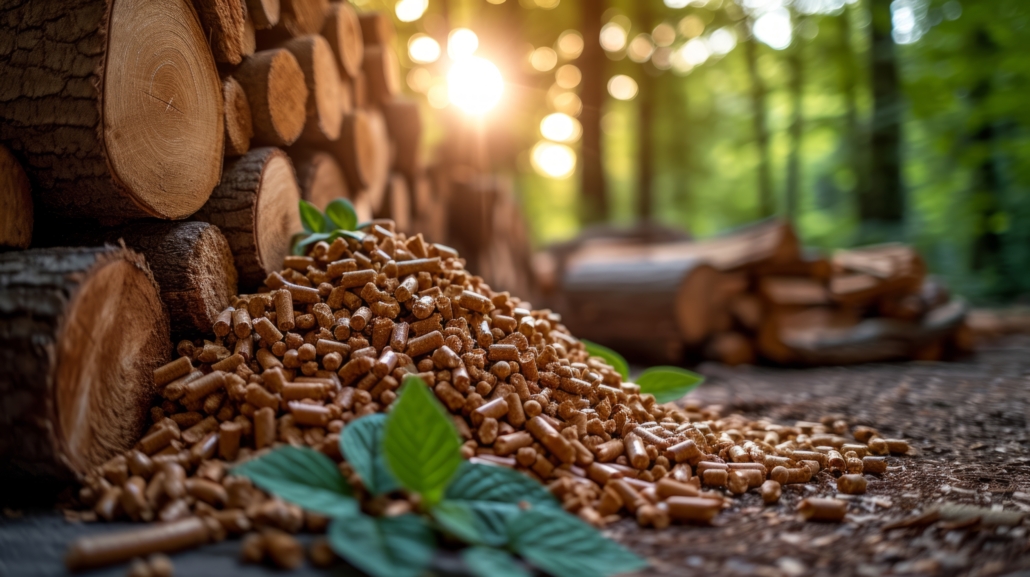
Biomass: renewable or non-renewable?
When we search for ‘is biomass renewable or non-renewable’, the short answer is: yes, but it depends. It depends on the origin of the resource, its sustainability and how it is managed over time. Here I explain it clearly, with official EU criteria and examples to help you act with confidence.
Biomass, bioenergy and the key distinction
- Biomass: organic matter of plant or animal origin (and by-products of its transformation).
- Bioenergy: renewable energy obtained by converting that biomass into heat, electricity or fuels (biogas/biomethane, biofuels).
So… is biomass renewable or non-renewable?
The European Union considers biomass to be a renewable source provided that it meets the sustainability and emission savings criteria set out in the Renewable Energy Directive (RED II/RED III). Since 2018/2023, these criteria apply to solid and gaseous biomass for heat/electricity and to biofuels for transport (forestry, agricultural, waste and GHG savings sustainability).
The IPCC points out that the climate contribution of bioenergy depends on the carbon cycle, land use, resource regeneration time and the replacement of fossil fuels. In short: not all biomass is automatically “neutral”; management matters.
Official summary of the Renewable Energy Directive and its 2030 targets. Energy
Criteria that make the difference (and turn ‘it depends’ into ‘yes’)
- Sustainable origin
- Forest/agro-industrial residues, by-products, pruning and bio-residues → better renewable fit.
- Unsustainable logging or use that competes with carbon sinks → may not be acceptable under RED.
- Verifiable emissions savings
- GHG thresholds compared to fossil fuel equivalent (applies to solids, gases and biofuels).
- Chain of custody/certification
- Voluntary schemes recognised by the European Commission to certify sustainability.
- Technology and operation
- Efficient boilers and filters, stable fuels (size, moisture) and local emissions control (IDAE).
Quick examples: when yes and when no?
- Yes, renewable
- Municipal pruning chips, forestry cleaning residues and sustainably managed wood by-products → thermal energy/CHP.
- Biowaste and sludge → biogas/biomethane with accredited GHG savings.
- Caution
- Forest biomass that does not meet sustainability criteria or degrades sinks → may not count as renewable according to RED.
Context in Europe: useful data
Renewables continue to grow in the EU (target ≥42.5% in 2030), and bioenergy continues to play a key role, especially in heating and thermal processes.
How to get started with biomass, right the first time (practical plan)
- Resource map: what do you have nearby? (pruning, wood waste, organic waste, sludge).
- Pre-treatment: shredding/screening and moisture control → stable fuel (pellets/chips).
- Technology: thermal/CHP or anaerobic digestion depending on flow.
- Sustainability and GHG: verify that you comply with RED II/RED III and certify the chain.
- Local emissions: equipment and operation in accordance with IDAE guidelines.
- KPIs: CO₂e savings, cost €/MWh, % of waste recovered.
Would you like a preliminary assessment (resources, technology, CAPEX/OPEX and RED compliance)? → Let’s talk.
Recommended reading
-
European Commission — Renewable Energy Directive (RED) (text and frequently asked questions). Energy
-
IEA — Bioenergy (sector monitoring and explainers). IEA
-
IPCC — Climate Change and Land (bioenergy and land use). ipcc.ch
-
Eurostat — Renewable energy statistics (series and fact sheets 2023–2024). European Commission
-
IDAE — Biomass (Spain) (definitions, technical guides). idae.es
Conclusion
The question ‘is biomass renewable or non-renewable’ can be answered rigorously as follows: it is renewable when it meets sustainability and emission savings criteria. With a good source of the resource, certification and appropriate technology, bioenergy reduces CO₂ and recovers waste. The challenge lies in designing the project well and measuring it.
Would you like to evaluate biomass for your operation (resource, technology and RED compliance)? → Talk to our team.






Leave a Reply
Want to join the discussion?Feel free to contribute!