
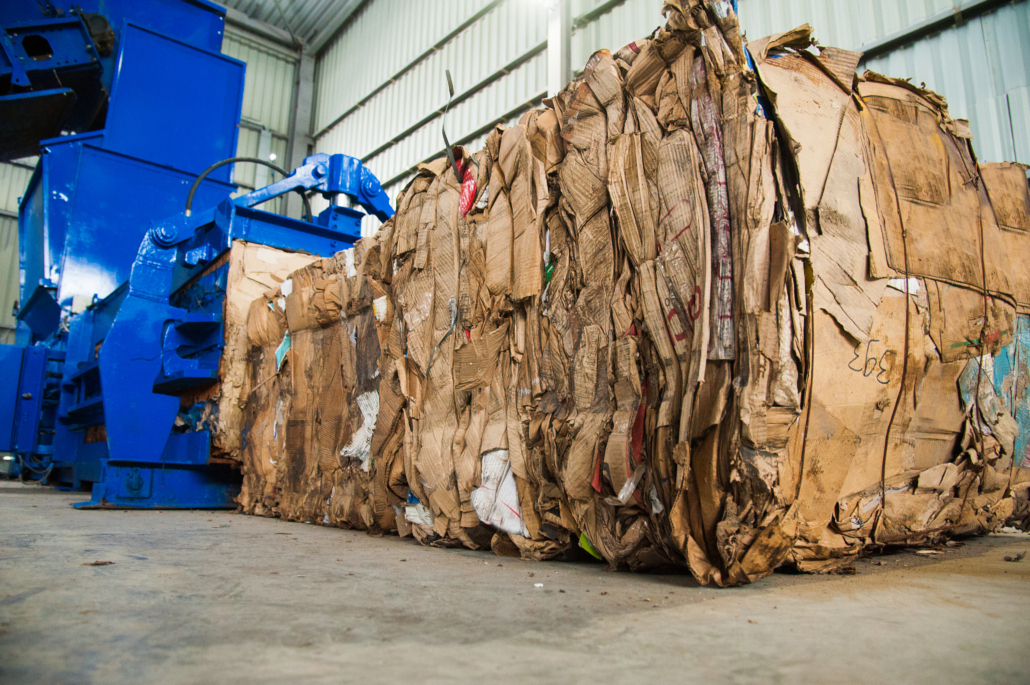
What machinery a paper and cardboard recycling plant needs
A paper and cardboard recycling plant needs five blocks of equipment: feeding and dosing, shredding, screening by size, density separation and conveying between stages. The specific configuration of each block depends on the input material —corrugated cardboard, office paper, mixed fraction or packaging— and on the throughput in tonnes/hour the line has to process.
This guide runs through each stage, the equipment involved and the criteria that determine its sizing.
Overview: the complete line at a glance
| Stage | Function | Equipment |
|---|---|---|
| 1. Feeding | Regulate the input flow and avoid load peaks | Dosing systems |
| 2. Shredding | Reduce volume and homogenise particle size | Shredders / hammer mills |
| 3. Screening | Separate by size and remove fines and contaminants | Trommels |
| 4. Separation | Split light (paper, film) from heavy (metals, inerts) | Density separators |
| 5. Conveying | Connect stages and feed sorting cabins | Conveyor belts and apron conveyors |
1. Feeding and dosing: the bottleneck almost no one sizes correctly
Paper and cardboard arrive at the plant in bales, in bulk or mixed with other fractions. If that input is not regulated, the shredder receives load peaks that spike consumption, accelerate blade wear and force the line to stop.
Dosing systems solve this problem: they store the material and release it at a constant rate through flow regulation with frequency-controlled units. In practice, a well-sized doser is what allows the rest of the line to run at a stable rate rather than in fits and starts.
Sizing criterion: hopper capacity large enough to absorb the full discharge of a truck without stopping the feed downstream.
2. Shredding: reduce volume before sorting
Paper and cardboard are light, bulky materials. Shredding them before sorting multiplies their bulk density, reduces the cost of internal transport and makes subsequent screening possible.
For these materials the reference equipment is the hammer mill, designed to fragment light, brittle materials into fine particles. Single-shaft or multi-shaft industrial shredders are used when the input fraction arrives mixed with rigid plastics, wood or metals.
A specific case is the industrial paper shredder, aimed at the secure destruction of confidential documentation as well as at preparing the material for recycling. If the plant handles archives from companies or public authorities, this equipment covers two needs with a single investment.
Sizing criterion: the target output size determines the choice of blades and the power. The finer the output, the higher the consumption per tonne.
3. Screening: separate by size with a trommel
After shredding, the material passes through a perforated rotating cylinder that classifies it by particle size through continuous screening. Screening trommels process everything from paper and cardboard to refined organic fractions, and on a paper line they perform two functions at once:
- Remove fines: paper dust, loose staples, fragments below the usable size.
- Split the flow: separate the coarse fraction (corrugated cardboard) from the fine one (paper), which follow different recovery routes.
Sizing criterion: the drum diameter and length determine the residence time; the mesh aperture defines the particle-size cut.
4. Density separation: remove what is not fibre
This is the stage that makes the difference between a recovered material of commercial quality and one penalised for contaminants. Density separators divide light materials from heavy ones by means of an air stream, isolating the paper and cardboard fibre from metals, inerts, glass and rigid plastics.
Air separation technology achieves efficiencies of over 99% on solid waste, and it is what makes it possible to reach the contaminant levels that paper mills demand.
Sizing criterion: the airflow and the chamber geometry are adjusted to the density difference between the fractions to be separated.
5. Conveying: the line that connects everything
Material has to be moved between each stage, and in a paper and cardboard plant conveying is not an accessory: it defines the entire layout and the accessibility for maintenance.
- Belt conveyors cover the horizontal and inclined sections and feed the manual sorting cabins.
- Apron conveyors are used on steeply inclined sections or with abrasive material, where a rubber belt would suffer premature wear.
Sizing criterion: belt width according to throughput, speed according to the sorting time required in the cabin.
How the line changes according to the input material
Not all paper and cardboard plants are configured the same way. The input material determines which stages are critical:
| Input material | Critical stage | Recommended configuration |
|---|---|---|
| Large-format corrugated cardboard (OCC) | Shredding | High-capacity shredder + coarse screening |
| Office paper and archives | Secure shredding | Industrial paper shredder + fine screening |
| Mixed fraction from selective collection | Separation | Trommel + reinforced density separation |
| Paper and cardboard with light packaging | Separation | Multi-stage density separation |
How to size a paper and cardboard recycling plant
Before selecting specific equipment there are three variables that condition the entire design:
- Input throughput (t/h): it determines the power of the shredder and the width of the belts. Oversizing raises the investment; undersizing turns a stage into a permanent bottleneck.
- Material composition: the percentage of contaminants defines how much separation capacity is needed. Clean material of industrial origin requires fewer stages than municipal collection.
- Required output quality: the final destination —national paper mill, export, RDF— sets the admissible level of contaminants and, with it, the sophistication of the separation.
From those three figures the rest is calculated: floor area needed, installed power, number of operators in the cabin and return on investment.
Why integrate the whole line with a single manufacturer
Buying separate equipment from different suppliers creates a recurring problem: each machine works to specification, but the complete line does not reach the expected performance because the stages are not synchronised with one another.
At Reverter Industries we have been manufacturing machinery and installing plants across Europe for more than 75 years, and we design each paper and cardboard recycling plant from scratch according to the material to be processed and the input volume, integrating shredding, sorting, density separation and automated control into a single line.
In-house manufacturing in Spain, direct technical service and the ability to work on any stage of the installation without relying on a third party.
👉 Explore our paper and cardboard recycling plants or tell us about your project and we will study the right configuration.
Frequently asked questions
What machinery does a paper and cardboard recycling plant need? Five blocks of equipment: dosing systems to regulate the feed, shredders or hammer mills to reduce volume, trommels to screen by size, density separators to remove contaminants and conveyor belts to connect the stages.
Can paper and cardboard be recycled without shredding it first? Technically yes, but performance drops. Unshredded paper and cardboard have a very low bulk density, which raises the cost of internal transport and prevents subsequent screening by particle size.
What is the difference between a trommel and a density separator? The trommel separates by size through rotary screening; the density separator separates by density through an air stream. In a paper and cardboard plant they are used in a complementary way: first the material is split by size and then the heavy contaminants are removed.
How much floor area does a paper and cardboard recycling plant need? It depends on the input throughput and on whether storage of input material and finished product is considered. The sizing is calculated from the tonnes/hour to be processed and the days of stock planned.
Can an existing plant be expanded by adding stages? Yes, as long as the original layout allows it. The most common expansions are adding a density separation stage to improve output quality or increasing shredding capacity.