
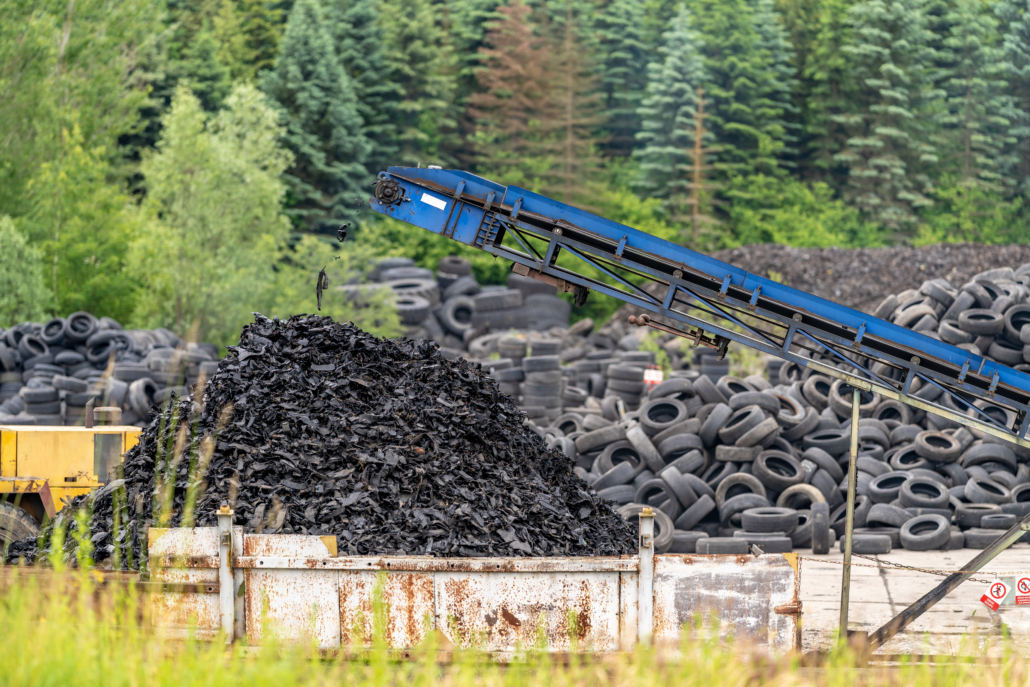
Tyre recycling process: stages and machinery
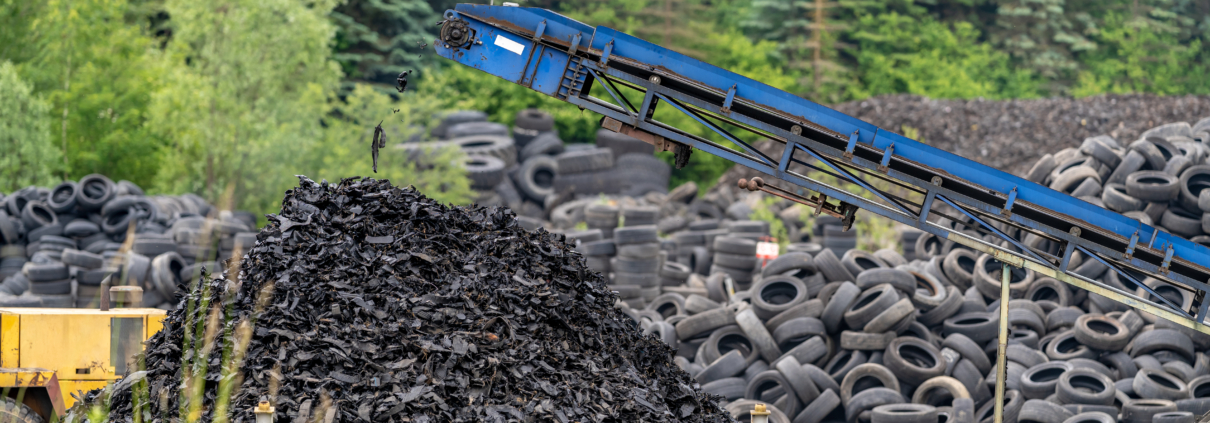
The tyre recycling process transforms a complex, bulky waste stream into distinct fractions that can be reused. To achieve this, tyres arriving at a treatment facility go through different stages of sorting, size reduction, separation and screening.
The exact configuration of a tyre recycling plant depends on the type of input material, the treatment capacity required and the final product to be obtained. Reducing whole tyres to make them easier to handle is not the same as producing a rubber fraction with a controlled particle size.
In this article we explain how tyres are recycled, what happens at each stage and what machinery is involved in an industrial treatment line.
How are tyres recycled?
Tyre recycling generally consists of progressively reducing their size and separating the materials they are made of.
Before mechanical treatment begins, tyres are received, inspected and sorted. Those that cannot be reused or retreaded move on to the treatment lines, where they may undergo primary shredding, steel separation, secondary reduction, fibre separation and size classification.
The goal is to obtain fractions that are as homogeneous as possible and to prepare the material for subsequent recovery or transformation.
In simplified terms, a line can follow this scheme:
Reception and sorting → preparation → primary shredding → steel separation → secondary reduction or granulation → fibre separation → screening and classification.
Stages of the tyre recycling process
1. Reception and sorting of tyres
The process begins with the reception of tyres at the facility.
Before shredding, their condition must be determined and they must be sorted according to their characteristics. Some tyres can follow other recovery routes, while those destined for material recycling move on to the mechanical treatment stages.
Depending on the plant design, this stage may include storage, controlled feeding, pre-cutting or preparation of the tyre before it is fed into the shredder.
Regular feeding is important to maintain a stable flow and avoid overloading the equipment further downstream.
2. Primary shredding
Tyre shredding is one of the most important stages of the process.
Tyres are tough, elastic materials reinforced with metal components. For this reason, the shredding equipment must be able to work with materials that are difficult to tear apart and withstand demanding industrial conditions.
In this first reduction, the whole tyre is transformed into smaller pieces. This makes it easier to transport within the facility and prepares the material for the subsequent separation and reduction stages.
Twin-shaft shredders are one of the technologies used for this type of application, since their counter-rotating rotors are able to grip, cut and tear bulky materials.
At Reverter Industries we work with SatrindTech shredders for tyres, whose configuration must be selected according to input size, treatment throughput and the required result.
3. Steel separation
After the first reduction, separation of the different materials present in the tyre begins.
One of the main fractions is the steel used as structural reinforcement. As these elements are progressively released during shredding, magnetic separation systems can be used to remove them from the material flow.
The efficiency of this stage matters for two reasons: it allows a usable metal fraction to be recovered, and it prevents steel from unnecessarily continuing on to the subsequent reduction and classification equipment.
Depending on the process, separation can be carried out at more than one point in the line to improve the cleanliness of the different fractions.
4. Secondary reduction and granulation
Once the first shredding has taken place and part of the metal elements have been removed, the material can move on to a second reduction stage.
The goal is to progressively reduce the size of the rubber until the particle size required by the process is reached.
Depending on the desired final product, secondary shredders, granulators or other reduction equipment can be used. This stage must be sized taking into account the feed capacity, the size of the pieces coming from primary shredding and the required output size.
The smaller and more homogeneous the final fraction needs to be, the more important it becomes to correctly control the different reduction stages.
5. Textile fibre separation
Besides rubber and steel, tyres contain textile materials that must be separated during the recycling process.
After the reduction stages, these fibres become more exposed and can be extracted using specific separation and extraction systems.
Correctly removing the textile fraction helps improve the purity of the recovered rubber and eases subsequent classification operations.
The technology used will depend on the design of the facility and the quality requirements of the final product.
6. Screening and classification by particle size
The last part of the mechanical process consists of classifying the material according to the size obtained.
Screening systems make it possible to separate different particle sizes and return to the circuit any particles that still need further reduction.
This recirculation system helps achieve a more uniform final product and allows the process to be adjusted to different output requirements.
Tyre recycling, therefore, does not depend on the shredder alone. It is the result of the coordinated combination of feeding, shredding, separation, conveying and classification equipment.
What machinery is used to recycle tyres?
A tyre recycling line can incorporate different equipment depending on the capacity required and the final product.
| Process stage | Typical machinery | Main function |
|---|---|---|
| Reception and feeding | Hoppers, dosers and conveyors | Regulate the input of material |
| Preparation | Cutting or pre-preparation equipment, depending on the process | Ease subsequent treatment |
| Primary shredding | Industrial shredder | Reduce the whole tyre into manageable pieces |
| Metal separation | Magnetic separators | Recover steel and remove metals from the flow |
| Secondary reduction | Secondary shredders or granulators | Progressively reduce the size of the rubber |
| Fibre separation | Extraction or separation systems | Remove textile components |
| Classification | Screens | Separate the material by particle size |
| Internal conveying | Belts and conveyors | Connect the different stages of the line |
Choosing the tyre recycling machinery must be done as a whole. Correctly sizing a shredder but not the feeding, conveying or classification systems can limit the capacity of the entire facility.
For this reason, in industrial projects it is advisable to study the complete process rather than each piece of equipment in isolation. You can browse our range of recycling machinery to learn about the different technologies that can be integrated into a treatment line.
What materials are obtained from tyre recycling?
Mechanical treatment mainly separates three major fractions: rubber, steel and textile materials.
Recycled rubber
Rubber represents the main fraction sought for recovery.
Depending on the reduction and classification stages, it can be obtained in different sizes, from shredded pieces to rubber granulate with a finer particle size.
The final use determines the level of reduction, cleanliness and homogeneity required. That is why, before designing a facility, it is important to define which product is to be obtained.
Recovered steel
The metal elements built into tyres can be separated using magnetic systems as they are released during shredding.
The goal is to obtain a metal fraction separated from the rubber and prevent it from continuing on to the subsequent stages.
Textile fibre
The textile fraction is progressively released during the shredding and granulation stages.
Separation systems make it possible to remove it from the rubber to improve the quality of the fractions obtained and to ease their subsequent management or recovery.
How is a tyre recycling plant designed?
There is no single configuration valid for every facility.
The design of a tyre recycling plant must start from the actual characteristics of the project. Before selecting machinery, it is advisable to define at least:
- Type and dimensions of the tyres to be received.
- Treatment capacity required.
- Planned operating hours.
- Maximum input size.
- Desired final particle size or size.
- Purity required for the recovered fractions.
- Feeding system.
- Need for material recirculation.
- Separation equipment required.
- Available space and plant layout.
- Level of automation.
- Conveying equipment between processes.
A machine’s nominal capacity alone does not determine the actual output of a line. The facility must be balanced so that the different stages can work continuously and in a coordinated way.
At Reverter Industries we design and integrate recycling plants adapted to the characteristics of the waste and the needs of each project.
The role of the shredder in a tyre recycling line
The shredder shapes much of how the subsequent stages perform.
Its job is not just to reduce the volume of the tyre. Cutting geometry, output size, treatment capacity and feeding regularity all directly influence the downstream separation and reduction processes.
To select a piece of equipment, variables such as the following must be analysed:
- Tyre dimensions.
- Material composition.
- Input size.
- Required output.
- Target output size.
- Cutting technology.
- Blade configuration and thickness.
- Installed power.
- Equipment located before and after the shredder.
Within the SatrindTech range, models such as the K30 cover tyre applications. The final selection, however, must be made based on the actual working conditions and the line as a whole.
If you want to compare different reduction technologies for other waste streams and applications, also check our range of industrial recycling shredders.
Recycling and management of end-of-life tyres
The industrial recycling process is only one part of managing tyres at the end of their useful life.
Before treatment, aspects such as collection, sorting, traceability, reuse, retreading and delivery to authorised operators and facilities must be considered.
In this article we have focused specifically on the technical side of the treatment and the machinery needed to transform the material.
To learn more about the regulations, obligations and management of end-of-life tyres, you can read our guide on environmental management of tyres.
Frequently asked questions about tyre recycling
How are used tyres recycled?
Tyres destined for recycling are sorted and go through different reduction and separation stages. The process typically includes primary shredding, steel separation, secondary reduction, textile fibre separation and screening by size.
What machinery is needed to recycle tyres?
It depends on the final product and the capacity of the facility. A line can integrate feeding systems, industrial shredders, magnetic separators, secondary reduction or granulation equipment, fibre separation systems, screens and conveyors.
Why are tyres shredded?
Shredding reduces the size and volume of the tyre, progressively releases the different materials it is made of, and prepares the waste for the subsequent stages of separation, classification and recovery.
What materials can be recovered from a tyre?
Mechanical treatment mainly separates rubber, steel and textile materials. The degree of cleanliness and the size of the fractions depend on the configuration of the line and the treatment stages installed.
What is the difference between shredding and granulating tyres?
Shredding carries out an initial or intermediate reduction of the tyre’s size. Granulation corresponds to a more advanced reduction stage aimed at obtaining smaller particles with a more controlled particle size.
Are all end-of-life tyres shredded?
Not necessarily. Before recycling, tyres must be sorted. Some can be directed to other recovery routes when their condition allows it, while those destined for material recycling move on to the corresponding mechanical treatment processes.
A recycling line must be designed as a complete process
The tyre recycling process combines several technologies that must work in a coordinated way. Shredding is essential, but its performance depends on how feeding, separation, secondary reduction, conveying and screening are integrated.
For this reason, the design of a facility must start with the waste to be treated and the product to be obtained. From this information it is possible to define the technology and correctly size each stage.
At Reverter Industries we study every project to select and integrate the most suitable recycling machinery for the process.
Are you planning a treatment line or do you need to size a tyre shredding system? Contact Reverter Industries and we will analyse your project’s needs.