
Conveyor belt parts: a complete guide to its components
There are six parts to a conveyor belt: the frame or load-bearing structure, the belt itself, the pulleys (drive and return), the rollers (carrying, return and impact), the drive system (motor, gearbox and variable frequency drive) and the auxiliary components for tensioning, alignment, cleaning and safety.
Each component performs a specific function, and its selection determines the load capacity, durability and operational continuity of the equipment. In recycling plants, where the material is abrasive and irregular, choosing a single component poorly translates into unplanned downtime and premature wear across the whole system.
Conveyor belt components: summary table
| Component | Main function | Materials or variants |
|---|---|---|
| Frame | Supports the load and stabilises the conveying path | Carbon steel, stainless steel |
| Belt | Conveying surface in contact with the material | PVC, rubber, polyurethane, stainless mesh |
| Drive pulley | Transmits motor power to the belt | Rubber or ceramic lagging |
| Return pulley | Guides the empty belt and increases the wrap angle | Steel, no drive force transmitted |
| Rollers | Reduce friction and absorb impact | Carrying, return, impact |
| Geared motor | Converts revolutions into starting torque | Three-phase motor + gearbox |
| Tensioners and guides | Maintain belt tension and tracking | Manual, automatic, self-aligning |
The frame: the load-bearing structure
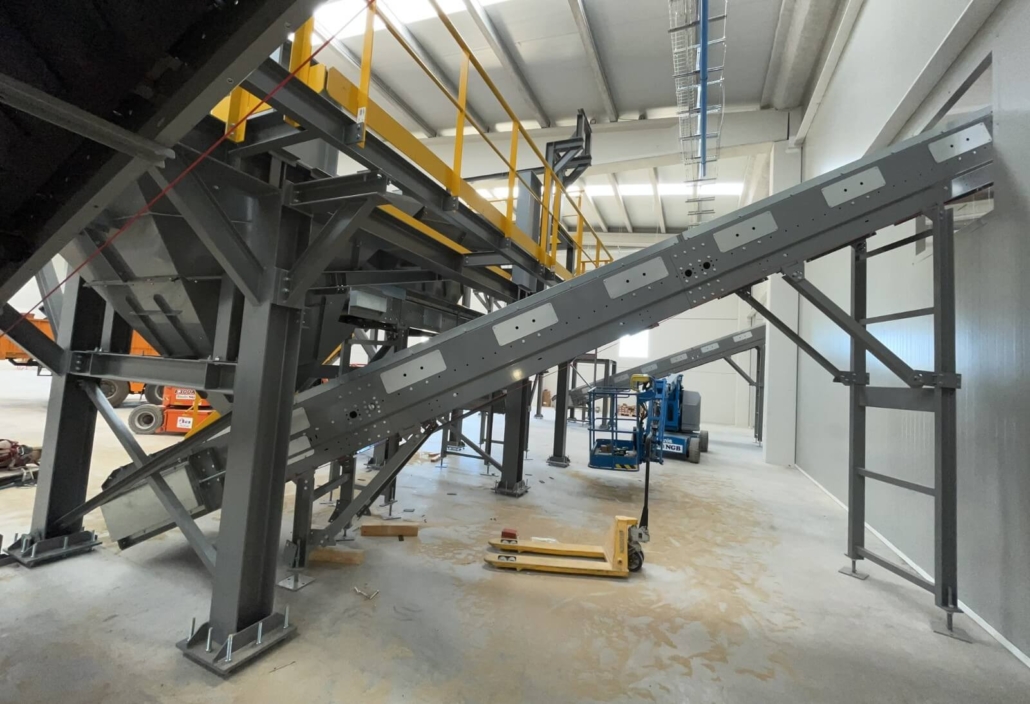
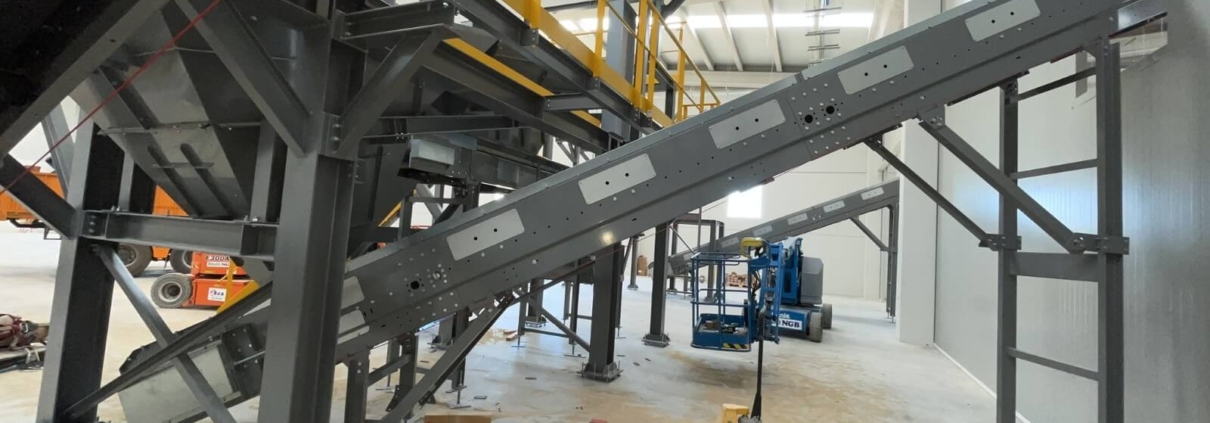
The frame is the metal skeleton that supports every component and keeps the conveying path stable under load.
- Carbon steel: withstands the weight under standard industrial conditions.
- Stainless steel: mandatory in the food and chemical sectors due to hygiene requirements.
It is completed with lateral fixing elements: railings that anchor the structure to external columns and clamps that join the modular sections of the frame, allowing the installation to be extended or reconfigured without rebuilding it.
The conveyor belt: materials and tension
The belt is the working surface that interacts directly with the waste. Its selection defines the capacity and service life of the entire system.
Materials by application
- PVC: lightweight packaging and processes requiring simple cleaning.
- Rubber: withstands the abrasive wear of plastics and inert material; reinforced rubber prevents punctures from sharp loads.
- Polyurethane: wet and greasy environments.
- Stainless steel mesh: processes involving intensive washing. Its open design aids drainage and prevents the build-up of organic matter.
Smooth or cleated surface
Smooth surfaces are used for general horizontal conveying of loose material. Cleats prevent the load from sliding on inclined sections.
Why tension is critical
Insufficient tension causes the belt to slip on the pulleys and lose efficiency. Excessive stretching accelerates the wear of the internal bearings. Both extremes end in line stoppage.
At Reverter Industries we configure the belt according to the waste to be processed, from packaging and stretch film to RDF/SRF, batteries and municipal solid waste.
Drums and pulleys: how movement is transmitted
Drive pulley
This is the cylinder that transmits the motor’s rotational power to the belt. Its surface is lagged with rubber or ceramic to maximise friction and prevent slippage. Effective traction is what keeps the conveying speed constant.
Return and deflection pulleys
Located at the opposite end or at strategic points, the return pulley guides the empty belt back to the loading point without transmitting drive force. It keeps the path correct and can increase the wrap angle on the drive pulley, optimising traction in long or complex installations.
Types of conveyor belt rollers
- Carrying rollers (upper run): support the weight of the material. They reduce friction between belt and structure, enabling smooth rotation that consumes less energy. They must be robust enough not to deform under stress.
- Return rollers (lower run): support the weight of the empty belt and stabilise the return run, preventing vibration and misalignment.
- Impact rollers: installed where material drops from hoppers. Made up of spaced rings, they absorb the force of the fall and protect the belt from punctures and premature wear.
The electrical drive system
Motor and gearbox
The electric motor, generally three-phase, is the primary source of power. The gearbox converts high revolutions into an adjusted speed and high torque, multiplying the force available to move heavy loads. The combination allows a soft start and protects the system against sudden blockages.
Variable frequency drives
They adjust motor speed in real time according to the load present. They optimise energy consumption, smooth out starts and stops, reduce mechanical stress on every component and extend the service life of the equipment.
Tensioning and alignment systems
Manual versus automatic tensioners
Manual systems require periodic intervention using adjustment screws. Automatic ones use counterweights or compressed air to keep tension stable in the face of thermal or load changes, reducing machine downtime.
Self-aligning rollers
They correct minor deviations by pivoting slightly on their axis. They straighten the belt autonomously, prevent rubbing against the structure and ensure uniform wear at the edges.
Lateral guarding
Fixed or adjustable guides that keep the material centred. They prevent the belt from running off its axis and protect both the mechanical components and personnel safety during loading.
Cleaning and safety components
- Return-run scrapers: remove waste stuck to the inner face of the belt. They prevent build-up that would unbalance the pulleys or contaminate the downstream process. Installed near the discharge points, they deliver maximum effectiveness.
- Transfer tables and heads: ease the passage of material between stages, reduce direct impact on the belt and prevent packaging or fragile fragments from breaking.
- Presence and level sensors: detect the actual load in order to start or stop the motor, optimising consumption and protecting the machinery from overloads.
- Emergency stops: mandatory under safety regulations. Their series design allows activation from any accessible point in the event of entrapment risk or mechanical failure.
Component maintenance
Constant friction at the support points degrades the shafts. Periodic lubrication of the bearings with high-quality greases reduces the heat generated and extends the life of the moving parts.
Preventive inspections avoid unexpected downtime: keeping tension and alignment correct reduces energy consumption and optimises the plant’s daily operating costs. Read our complete guide to conveyor belt maintenance to set up an inspection plan.
Frequently asked questions about conveyor belt parts
What are the main parts of a conveyor belt?
The frame, the belt, the drive pulley, the return pulley, the carrying, return and impact rollers, the geared motor with variable frequency drive, the tensioning and alignment systems, and cleaning and safety components such as scrapers and emergency stops.
What is the difference between the drive pulley and the return pulley?
The drive pulley transmits the motor’s power to the belt and is lagged with rubber or ceramic to maximise friction. The return pulley transmits no drive force: it guides the empty belt and can increase the wrap angle on the drive pulley to improve traction.
What types of rollers does a conveyor belt have?
Three. Carrying rollers, on the upper run, support the weight of the material. Return rollers, on the lower run, support the empty belt. Impact rollers sit beneath the discharge points from hoppers and absorb the force of the fall.
Which belt material is best for a recycling plant?
It depends on the waste: reinforced rubber for abrasive or sharp material, PVC for lightweight packaging, polyurethane in wet and greasy environments, and stainless steel mesh in processes with intensive washing, thanks to its drainage and hygiene.
What happens if the belt does not have the correct tension?
Insufficient tension makes the belt slip on the pulleys and reduces efficiency. Excessive tension accelerates bearing wear. Automatic tensioners with a counterweight or air keep the adjustment stable on a continuous basis.
Every component, designed for your process
Knowing the parts of a conveyor belt is the first step; the second is configuring them according to the material, the throughput and the conditions of your plant. Discover our belt conveyors, see the types of conveyor belts and their applications or talk to our technical team to design a tailor-made solution within your recycling machinery line.